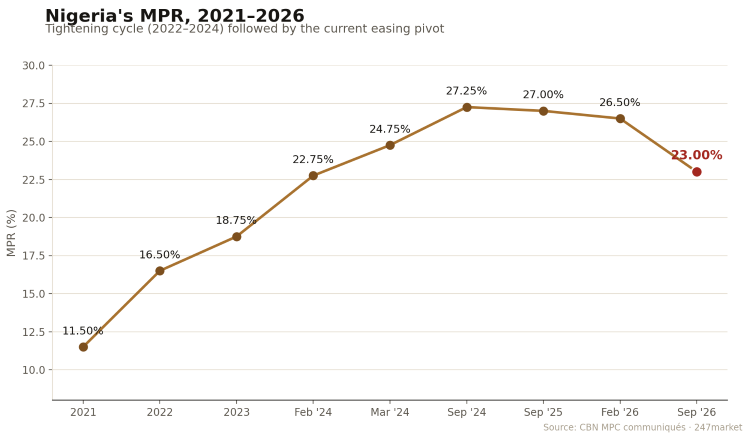
The Central Bank of Nigeria's Monetary Policy Committee delivered its boldest move in years on September 22, 2026, cutting the Monetary Policy Rate (MPR) by 350 basis points — from 26.50% to 23.00%. It is the largest single MPR cut in the in two decades.
It beats market expectations and confirms Nigeria is now firmly in an easing cycle after two brutal years of monetary tightening.
Here's a full breakdown of what the MPR is, how we got here, why this cut matters, and — most importantly — where capital is likely to move next.
01What the MPR Is, and Why Everyone Watches It
The MPR is the benchmark rate at which the CBN lends to deposit money banks. It's the anchor for Nigeria's entire rate structure: Treasury bill yields, bond pricing, bank lending and deposit rates all move off it, directly or indirectly.
The CBN doesn't manage this number alone. It operates through a Standing Facilities Corridor, a band around the MPR that sets what banks pay to borrow overnight and what they earn parking excess cash. This week's decision recalibrated that corridor to +50/-300 basis points, narrower than the prior +50/-450 spread — a technical move Governor Cardoso said was meant to sharpen policy transmission, not signal a change in underlying stance.
The CBN also held the Cash Reserve Ratio steady at 45% for deposit money banks, 16% for merchant banks, and 75% on non-TSA public sector deposits.
This is exactly why analysts, bankers and portfolio managers treat every MPC verdict as a market-moving event: it resets the relative attractiveness of cash, bonds and equities in one sitting. It signals how the central bank is weighing inflation against growth.
02Nigeria's MPR Trajectory: The Last Five Years
Context makes this cut make sense. Nigeria's rate path has been a five-year round trip from accommodation, through aggressive tightening, to today's pivot:
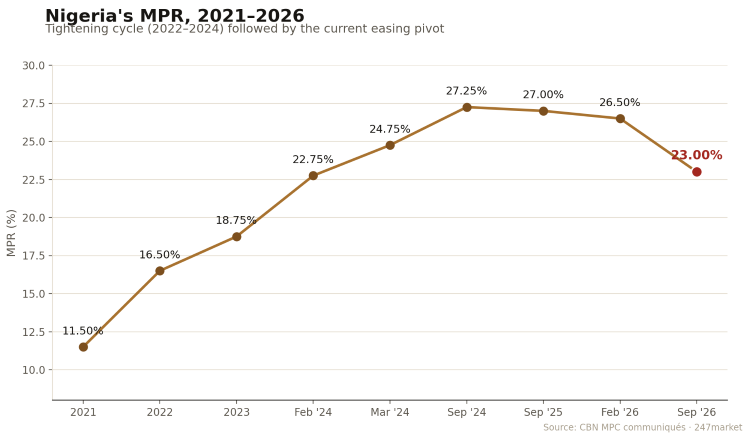
- 2021: MPR held at an accommodative 11.50%, a pandemic-recovery stance.
- 2022–2023: Aggressive tightening begins as inflation surges — the rate climbs to 16.50% by end-2022 and 18.75% by September 2023.
- 2024: Under newly appointed Governor Cardoso, tightening accelerates sharply — +400bps to 22.75% in February, +200bps to 24.75% in March, reaching 27.25% by September, among the highest levels in Nigeria's history.
- 2025: The rate peaks near 27.5% before the first pivot — a 50bps cut to 27% in September, as five straight months of disinflation gave the CBN room to ease.
- 2026: A further 50bps cut brings the rate to 26.5% in February, held through mid-year — and now the 350bps cut to 23% this week.
Five years, in short: relentless tightening to tame inflation that once approached 34%, followed by a cautious pivot that has now turned decisive.
03Why This Cut Stands Out
- Size and surprise: a Bloomberg survey found 5 of 8 economists expected a hold, with estimates capped at 26.5% — the CBN went well beyond consensus.
- Confirms a trend: it's the second cut of 2026, not a one-off — a genuine change in policy direction.
- Calibrated, not loose: CRR stayed at a punishing 45% and the corridor was tightened, not widened — the CBN is lowering the price of money while still controlling its volume.
04The Inflation Backdrop — Why Now
Monetary policy works with a lag: raising the MPR cools demand and slows inflation over time; cutting it does the reverse. The 2022–2024 hiking cycle was a direct response to inflation that peaked near 34%, and it has clearly worked — headline inflation has eased for three straight months, down to 15.39% year-on-year in August 2026 from 15.43% in July, and sharply below the 23.14% recorded a year earlier. Food inflation eased to 19.57% from 25.30% over the same period.
Crucially, at 23%, the MPR still sits roughly 7.6 points above headline inflation — Nigeria retains a strongly positive real interest rate. This kind keeps foreign portfolio money interested and supports the naira. This is room the CBN earned, not a reckless dash for growth.
Also Read: Making Sense of Nigeria's Disinflation Paradox
It also cited firmer external conditions: an expanding current account surplus that reached $7.54 billion in Q2 2026, buoyed by rising diaspora remittances, and improving external reserves.
05What It Means for Different Players
| Stakeholder | Likely Impact |
|---|---|
| Borrowers | Clear win — cheaper loans, better case for capex, SME expansion, consumer credit |
| Banks | Mixed — compressed margins as lending rates fall, but CRR at 45% still limits loanable funds; must chase volume |
| Fixed-income investors | New paper yields lower; existing higher-coupon holders see price gains |
| Equity investors | Historically the biggest beneficiaries — falling risk-free rates drive rotation into stocks |
Nigeria has a well-documented inverse relationship between fixed-income yields and equity performance: when risk-free returns fall, investors rotate into stocks chasing better returns. That pattern has repeated across past cuts, and the reverse held just as reliably during the tightening years. Once risk-free returns pushed north of 15%, equities routinely sold off as investors chased safer, higher-yielding paper.
Expect the strongest response in:
- Banking stocks — though near-term caution is possible around margin-compression concerns before loan growth offsets it
- Consumer goods & industrials — direct beneficiaries of cheaper working capital and firmer demand
- Real estate & construction-linked names — as project and mortgage financing costs ease
Caveat: MPC-day reactions aren't always clean — the real signal is the trend over the following weeks as portfolio rebalancing plays out, not the first session's move.
Also read: 10 Stocks to Watch as Nigeria Returns to Frontier Market Category
07Where the Funds Are Likely to Flow
- Near-term: rotation out of T-bills/money market into large-cap, liquid equities — tier-1 banks, consumer goods bellwethers, industrials
- Medium-term: pickup in real-sector lending — manufacturing, SME finance, consumer credit — if banks follow through
- Real estate: renewed interest as mortgage and project financing gets cheaper
- Watch point: foreign portfolio investors' T-bill "carry trade" appeal softens somewhat as nominal yields fall — worth tracking at coming OMO auctions
- Still relevant: dividend-yielding equities and real assets as an inflation hedge, given inflation remains in double digits
08Bottom Line for Investors
This is a genuine pivot, not a symbolic gesture. The scale of the cut, the corridor recalibration, and the fact that it's the second reduction this year all point to a CBN convinced that disinflation is durable enough to actively support growth. But the retained 45% CRR shows this is calibrated easing, not a loose-money experiment.
For portfolio positioning, this is a reasonable point to begin trimming outsized fixed-income overweights built up during the high-rate years and rotating incrementally into quality equities — while keeping enough duration in fixed income to still capture attractive real yields before any further cuts. The next MPC meeting in November will be the key test of whether this easing cycle continues.
247market.info — Investment Intelligence for the Nigerian & African Market. This analysis is for informational purposes and does not constitute investment advice.