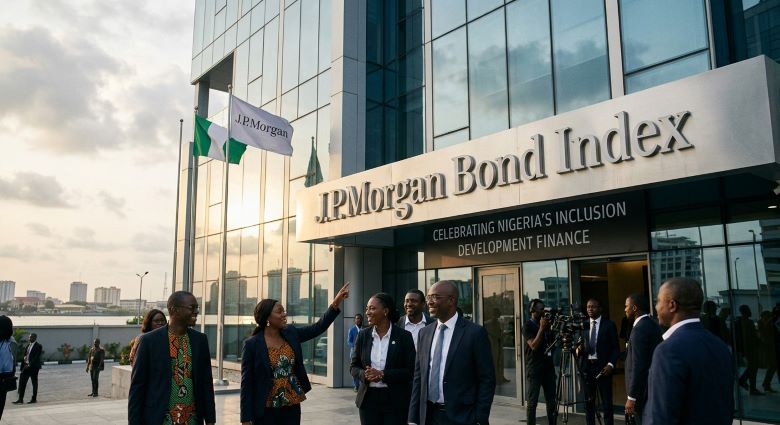
For more than a decade, Nigeria sat outside one of the world's most closely watched emerging-market investment benchmarks: J.P. Morgan's Bond Index
That changed in September 2026, when J.P. Morgan brought Nigerian government bonds back into one of its index families for the first time since 2015.
Institutional fund managers and policymakers have been excited by the development. However, for every Nigerian, the announcement and excitement may be confusing. He is probably asking a simple but important question: what actually is a bond index, and why does being included in, or excluded from it, matter so much?
This article provides answers: what it means, why Nigeria was removed from the index, and what has changed.
Whether you're a first-time investor trying to understand the headlines or a seasoned portfolio manager reassessing Nigeria's place in your frontier-market allocation, this article offers you value.
Also Read: Nigeria Returns to FTSE Russel Frontier Market Index
What Is a Bond Index, and What Is the GBI-EM?
A bond index is a benchmark - a standardized basket of bonds that tracks the performance of a defined segment of the debt market. Just as the S&P 500 tracks large U.S. companies, a government bond index tracks the debt issued by a group of countries, allowing investors to measure returns, compare markets, and build portfolios that mirror (or "track") that basket.
J.P. Morgan runs one of the most influential families of such benchmarks for developing economies: the Government Bond Index-Emerging Markets (GBI-EM) series. These indices measure the performance of local-currency government bonds, i.e debt issued and repaid in a country's own currency, such as the Nigerian naira, rather than in U.S. dollars.
The flagship version, the GBI-EM Global Diversified (GBI-EM GD), is the benchmark that global fixed-income fund managers most commonly use to decide how much of their portfolio to allocate to emerging-market government debt. Trillions of dollars in institutional capital is either directly invested in funds that replicate this index or is measured ("benchmarked") against its performance.
Because so much capital tracks or references these indices, inclusion is more than a symbolic honor. When a country joins, index-tracking funds are often required — by their own investment mandates — to buy that country's bonds in proportion to its assigned weighting.
Exclusion works the same way in reverse: funds that track the index are typically forced to sell, regardless of whether they think the country's economic outlook is otherwise attractive.
Why Nigeria Was Removed From the Index in the First Place
Nigeria was first admitted into J.P. Morgan's Bond Index in October 2012, a milestone that drew significant foreign portfolio investment into Nigerian debt, helped lower the government's borrowing costs by an estimated 200 basis points, and spilled over into stronger foreign inflows across equities and banking.
That inclusion did not last.
In January 2015, as falling global oil prices squeezed Nigeria's dollar earnings, the Central Bank of Nigeria tightened foreign-exchange controls to defend the naira. J.P. Morgan placed Nigeria on an "index watch," flagging three core concerns:
- Lack of liquidity for investors trying to convert naira back into dollars and move capital in and out of the country
- Lack of transparency in how the exchange rate was actually determined
- Restrictions that made routine currency transactions difficult for foreign participants
By September 2015, J.P. Morgan announced Nigeria's phased removal from the index, completed by the end of October that year.
For index-eligible markets, the ability to freely and transparently convert local currency is a non-negotiable requirement. Without it, foreign investors cannot reliably enter or exit their positions, which defeats the purpose of a tradable benchmark. Nigeria's exit triggered capital outflows and made the country a less visible destination for the large pools of money that follow index membership.
The setback compounded in 2022, when J.P. Morgan separately dropped its recommendation to overweight Nigerian sovereign debt within emerging-market portfolios, citing broader macroeconomic risks.
Why Is Nigeria Being Readmitted into J.P. Morgan's Bond Index
Nigeria's return into the family did not happen overnight.
It followed a multi-year effort to fix the structural FX problems that triggered the original removal — most notably reforms introduced from mid-2023 onward, when the Central Bank of Nigeria moved to unify its multiple exchange-rate windows and introduced a "willing buyer, willing seller" system intended to let the naira's value reflect actual market supply and demand rather than an administratively fixed rate.
These reforms came at a real short-term cost: a weaker naira and a sharp rise in inflation as the currency adjusted to more realistic levels. But over time, they restored two things foreign investors — and J.P. Morgan's index methodology — care about most: the ability to move money in and out of the country, and confidence that the exchange rate reflects genuine market conditions rather than opaque administrative decisions.
By April 2025, Nigerian authorities confirmed they were in active discussions with J.P. Morgan about a possible return to the bank's bond benchmarks, pointing to measurable improvements in FX market transparency and liquidity. Nigeria's debt office also worked to deepen its domestic bond market, expanding outstanding issuance and trading activity under a Two-Way Quote System to meet the index's liquidity and market-size thresholds.
What Actually Happened in September 2026
On September 14, 2026, J.P. Morgan confirmed in its Global Index Research report that selected Federal Government of Nigeria (FGN) bonds had been included in a newly launched benchmark: the Government Bond Index–Emerging Markets Edge (GBI-EM Edge).
A few details matter here for anyone trying to understand the significance accurately:
- This is not the flagship index. The GBI-EM Edge is a separate, newly created benchmark designed specifically to track frontier and pre-frontier local-currency government debt markets — countries with improving, but not yet fully mature, access for international investors. It sits a step below the flagship GBI-EM Global Diversified index, from which Nigeria remains excluded.
- Nigeria received a 7.40% weighting in the new index — one of the largest single-country allocations, and close to J.P. Morgan's maximum permitted country weighting of 8%.
- $17.47 billion of Nigerian government bonds, spread across 16 instruments, are represented in the benchmark.
- The included Nigerian bonds carry an average yield to maturity of 17.1% — well above the index's overall average of roughly 10.4% — reflecting Nigeria's higher-risk, higher-return profile, alongside an average duration of 3.38 years and a B- sovereign credit rating.
- The GBI-EM Edge itself is substantial: it launched in 2017 covering 11 markets and about $56 billion in debt, and by August 2026 had grown to 26 markets, 425 instruments, and roughly $328 billion in tracked debt.
The development also arrived just days before a related but separate milestone: FTSE Russell's reclassification of Nigeria from "Unclassified" to "Frontier Market" status, effective September 21, 2026 — another signal that international index providers increasingly view Nigeria's capital markets as more accessible than they were a few years ago.
What This Means for Nigeria's Economy
For the Nigerian government and the broader economy, the practical implications fall into a few categories.
Lower borrowing costs. When index-tracking funds are required or incentivized to hold a country's bonds, demand for those bonds rises.
Higher demand typically pushes bond prices up and yields down — meaning the government can borrow more cheaply in future auctions. Nigerian officials have pointed to the roughly 200-basis-point reduction in borrowing costs that followed the original 2012 inclusion as a benchmark for what renewed access could achieve.
Fresh foreign portfolio inflows. Nigeria's Finance Ministry has projected that the inclusion could draw in the region of $17.5 billion in fresh capital into the domestic debt market over time, as funds that benchmark against the GBI-EM Edge adjust their holdings to reflect Nigeria's new weighting. It's worth noting this isn't an automatic, one-time transfer — it materializes gradually as asset managers rebalance portfolios.
Deeper, more liquid domestic bond markets. Greater foreign participation tends to increase trading volumes and improve price discovery in the domestic bond market, which can benefit both government and, eventually, private-sector borrowers who rely on healthy fixed-income markets as a pricing reference.
A signal, not a guarantee. Analysts are careful to note that the 7.4% weighting does not mean J.P. Morgan itself is investing that sum directly into Nigerian debt. It simply expands the pool of index-aware capital that may now consider Nigeria. The actual flow of money still depends on individual fund managers' own risk appetite, mandates, and views on Nigeria's macroeconomic trajectory.
What This Means for Investors
The opportunity
For yield-seeking investors, Nigeria's inclusion highlights a market offering one of the higher yields available within frontier local-currency debt — averaging 17.1% versus roughly 10.4% for the broader GBI-EM Edge basket.
For a global fixed-income investor diversifying across frontier markets, that yield premium can be attractive, particularly as it comes bundled with an improving (if still fragile) policy backdrop and independent third-party validation from both J.P. Morgan and FTSE Russell.
Retail and beginner investors don't need direct access to J.P. Morgan's institutional index products to benefit from this trend.
Exposure typically comes through:
- Emerging/frontier-market local-currency bond funds or ETFs that track or reference the GBI-EM family of indices
- Direct purchase of FGN bonds through Nigeria's Debt Management Office or licensed brokers, for investors already resident in or comfortable transacting in naira
- Diversified frontier-market fixed-income funds managed by asset managers who now have Nigeria within their eligible universe
The risks
Higher yield in emerging and frontier markets almost always compensates for higher risk, and Nigeria's case is no exception:
- Currency risk remains the central variable. Because these are naira-denominated bonds, a foreign investor's actual dollar return depends heavily on how the naira performs against the dollar over the life of the investment — not just the coupon rate. J.P. Morgan's own data shows the naira has posted positive FX returns in 2025 and 2026 after years of depreciation, but exchange-rate volatility historically has been Nigeria's Achilles' heel with international investors, and it was the direct cause of the 2015 exclusion.
- The B- sovereign credit rating signals continued elevated default and macroeconomic risk relative to investment-grade sovereigns.
- Oil dependency. Nigeria's fiscal and external accounts remain heavily influenced by crude oil prices and production, an exposure that can quickly reverse reform gains if global energy markets turn unfavorable.
- This is not full flagship-index membership. Nigeria remains outside the GBI-EM Global Diversified index, the benchmark with the deepest, most passive institutional capital behind it. Full reinstatement would require Nigeria to further demonstrate sustained liquidity and FX-market functionality over time — something Nigerian officials have publicly acknowledged as an ongoing goal rather than a completed task.
Frequently Asked Questions
Is Nigeria back in J.P. Morgan's main bond index? Not yet. Nigeria has been added to the newly launched GBI-EM Edge, a frontier-market benchmark, not the flagship GBI-EM Global Diversified index it was removed from in 2015.
Officials have described this as a step toward, rather than the completion of, full reinstatement.
Why does index inclusion affect a country's borrowing costs? Inclusion increases demand from funds that track or benchmark against the index, which tends to push bond prices higher and yields lower — effectively making it cheaper for the government to borrow in subsequent debt issuances.
What was the main reason Nigeria was removed from the index in 2015? Persistent foreign-exchange liquidity constraints and a lack of transparency in how the exchange rate was set, which made it difficult for foreign investors to freely move capital in and out of the country.
Is investing in Nigerian government bonds safe for foreign investors? No emerging or frontier-market government bond is risk-free. Nigerian FGN bonds included in the new index carry a B- sovereign credit rating and are exposed to currency, oil-price, and broader macroeconomic risk. Investors should weigh the higher yield against these risks and consider their own risk tolerance and time horizon.
The Bottom Line
Nigeria's return to a J.P. Morgan bond benchmark after eleven years somehow validates the currency reforms that the government has pursued since 2023. It restores a degree of international visibility to Nigerian government debt, creates the conditions for cheaper government borrowing and fresh portfolio inflows, and reflects a market that has rebuilt some of the liquidity and transparency it lost a decade ago.
But the distinction between the GBI-EM Edge and the flagship GBI-EM Global Diversified index matters.
This is a step on the road back to full index membership, not the destination. For investors, that nuance is the difference between treating this as a definitive turning point and treating it as what it actually is: credible evidence of progress, in a market that still carries real and well-documented risk.
This article is for informational and educational purposes only and does not constitute investment advice. Investors should conduct their own due diligence or consult a licensed financial advisor before making investment decisions.