Money Market Funds in Nigeria: The Complete Beginner's Guide to Growing Your Money Safely
Still letting your cash sit idle in a savings account earning next to nothing? Money Market Funds let you access the same short-term, high-quality investments banks and institutions use — with as little as ₦1,000, low risk, and returns of up to 20%+ per annum. Here's everything a beginner needs to know, including the 5 best-performing funds in Nigeria right now.
If you've ever left cash sitting in a savings account earning almost nothing. At the same time, inflation quietly eats into its value; a Money Market Fund (MMF) is probably the single easiest upgrade you can make to how you manage your money. It's low-risk, liquid, requires as little as ₦1,000 to start, and in 2026 it's delivering returns that comfortably beat what any Nigerian bank pays on savings.
This guide walks you through everything a beginner needs to know — what an MMF actually is, how it's built and how it works, how to invest in one, the pros and cons, how it differs from other money market instruments and other mutual funds, and the five best-performing funds in Nigeria right now.
1. What Is a Money Market Fund?
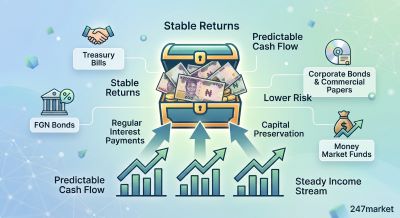
A Money Market Fund is a type of mutual fund that pools money from many investors and invests it in a basket of short-term, low-risk debt instruments — things like Treasury Bills, Commercial Papers, Bankers' Acceptances, and short-dated fixed deposits with reputable banks.
Instead of you individually trying to buy a ₦50 million Treasury Bill (which most retail investors can't afford), the fund manager pools your ₦5,000 with thousands of other investors' contributions and buys these instruments in bulk on behalf of everyone. You then own "units" of the fund proportional to how much you put in, and you earn a share of the interest the fund generates.
In simple terms: an MMF lets ordinary people access the same high-quality, short-term investments that banks and big institutions use — with small amounts of money and without technical expertise.
Money market funds in Nigeria are regulated by the Securities and Exchange Commission (SEC) and must be managed by SEC-licensed fund managers, which adds a layer of oversight and investor protection.
2. How a Money Market Fund Is Structured
Every MMF in Nigeria typically has these building blocks:
- The Fund Manager – A licensed asset management company (e.g., ARM, Stanbic IBTC, Coronation, DLM, Greenwich) that decides which instruments to buy, manages the portfolio daily, and is legally responsible for the fund's performance and compliance.
- The Trustee – An independent party (often a trustee firm) that holds the fund's assets on behalf of investors and ensures the fund manager doesn't misuse investor funds. This separation of "who manages" from "who holds the assets" is a core investor-protection feature.
- The Custodian – Safekeeps the actual securities and cash the fund owns.
- Unitholders – That's you. When you invest, you buy "units" of the fund at a fixed or near-fixed price (commonly ₦1, ₦100, or ₦1,000 per unit depending on the fund), and your returns accrue as additional units or as cash value.
- The Underlying Portfolio – A mix of Treasury Bills, Commercial Papers, Certificates of Deposit, Bankers' Acceptances, and short-term bank placements, all with maturities usually under 365 days.
This structure is what makes MMFs both safe and liquid: the underlying assets are short-term (so they mature and roll over quickly, limiting interest rate risk) and diversified (so no single default can wipe out the fund).
3. How a Money Market Fund Works
Here's the mechanism in practice:
- You invest — you transfer money (as little as ₦1,000–₦5,000 depending on the platform) into the fund.
- You receive units — priced at the fund's Net Asset Value (NAV) per unit, which for most Nigerian MMFs is fixed around ₦1 or ₦100 to keep things simple.
- The fund manager deploys the pooled cash into a diversified basket of short-term instruments, aiming for safety, liquidity, and yield — in that order of priority.
- Interest accrues daily — MMFs compute daily yield based on the interest earned on the underlying instruments, and this is usually credited to your account/reinvested as additional units, typically on a monthly basis.
- You can redeem (withdraw) — most funds allow redemption within 24–72 hours, making MMFs one of the most liquid investment options available, unlike fixed deposits which lock your money for a set term.
Your return is expressed as an annualized yield (e.g., "18.99% per annum"), but you earn it proportionally to how long your money stays invested — so ₦100,000 invested for 30 days at 19% per annum earns roughly ₦1,600 for that month, not 19% flat.
4. How to Invest in a Money Market Fund in Nigeria
Getting started is simpler than most people expect:
- Choose a fund manager or platform. You can invest directly through an asset management company (Stanbic IBTC, ARM, Coronation, FBNQuest, Greenwich, etc.) or through digital investment apps like Cowrywise, PiggyVest, Bamboo, Chaka, Rise, or Trove, which aggregate access to various funds.
- Complete your KYC. You'll need a valid ID (National ID, driver's license, international passport, or voter's card), a BVN, a passport photograph, and proof of address. This is a regulatory requirement.
- Fund your account. Transfer your desired amount — most platforms accept bank transfer, card payment, or direct debit.
- Get your units allocated. You'll receive a confirmation showing how many units you now hold and at what price.
- Monitor your returns. Most platforms show your growing balance daily or weekly as interest accrues.
- Withdraw when needed. Submit a redemption request; funds typically hit your bank account within 24–72 hours (some platforms are same-day for smaller amounts).
Tip for beginners: Treat an MMF as your first stop for an emergency fund, savings for short-term goals (rent, school fees, a planned purchase), or as a "parking spot" for money you're not ready to invest in higher-risk assets like stocks yet.
5. Benefits of Money Market Funds
- Low entry barrier — you can start with as little as ₦1,000–₦5,000, unlike Treasury Bills or fixed deposits which often require ₦50,000–₦100,000 minimums.
- High liquidity — access your money in 24–72 hours, far faster than fixed deposits or bonds.
- Attractive, inflation-beating returns — Nigerian MMFs have delivered yields between roughly 18% and over 20% per annum through 2026, well above the 1–4% typical commercial bank savings account.
- Low risk — the underlying instruments are short-term and mostly government or high-grade corporate debt, making capital loss rare (though not impossible).
- Professional management — you don't need to understand bond pricing or credit analysis; the fund manager does that for you.
- Diversification — your money is spread across multiple instruments and issuers, reducing concentration risk.
- Daily interest accrual — unlike some fixed instruments, your money starts earning from the day it's invested.
- Regulatory oversight — SEC regulation plus the trustee/custodian structure adds investor protection.
6. Drawbacks of Money Market Funds
- Returns aren't guaranteed — yields fluctuate with the interest rate environment; a fund earning 20% today could earn less if rates fall.
- Not risk-free — while rare, underlying commercial papers can default, and poorly managed funds can underperform or, in extreme cases, lose value.
- Inflation can still outpace returns — in periods of very high inflation, even a 19–20% yield may not fully preserve purchasing power in real terms.
- Management fees — funds charge an annual management fee (often 1–2%), which is usually already reflected in the quoted yield, but it's worth checking the fund's offer document.
- Not ideal for long-term wealth building — MMFs prioritize safety and liquidity over growth, so they generally underperform equities or real estate over a long horizon.
- Yield differences between funds can be significant — not all MMFs perform equally, so picking the wrong fund can mean leaving meaningful returns on the table.
7. The 5 Best Money Market Funds in Nigeria (July 2026 Rankings)
Based on year-to-date (YTD) yield data compiled by Nairametrics Research from SEC filings as of July 2026, these were the top five performing money market funds in Nigeria:
| Rank | Fund | Manager | YTD Yield | Unit Price |
|---|---|---|---|---|
| 1 | DLM Money Market Fund | DLM Asset Management Limited | 20.69% | ₦1,000 |
| 2 | Coronation Money Market Fund | Coronation Asset Management Limited | 20.22% | ₦1.00 |
| 3 | RT Briscoe Savings & Investment Fund | DLM Asset Management Limited | 20.13% | ₦1,000 |
| 4 | Greenwich Plus Money Market Fund | Greenwich Asset Management Limited | 19.11% | ₦100 |
| 5 | Myrtle Nest Money Market Fund | Myrtle Asset Management Limited | 19.09% | ₦1.00 |
A few notes worth flagging for beginners:
- DLM Money Market Fund climbed to the top spot in July, part of the DLM Capital Group. It's a smaller fund by assets under management, which can sometimes mean higher agility in chasing yield, but also less scale.
- Coronation Money Market Fund is the largest of the top five by assets under management (over ₦98 billion) and unitholder base (over 20,000 investors), making it a solid choice for beginners who prioritize scale and track record alongside yield.
- Greenwich Plus posted the strongest month-on-month improvement, jumping four places, which shows how rankings shift month to month — a reminder to check current data rather than relying on last year's "best fund" list.
Important caveat: rankings change monthly as interest rates, portfolio maturities, and fund inflows shift. Nigeria's money market fund industry now manages over ₦6.27 trillion across 48 registered funds (as of July 2026), so always check the latest published rankings (Nairametrics publishes monthly updates) and read a fund's fact sheet before committing significant capital. Past performance is not a guarantee of future returns.
8. Money Market Fund vs. Other Money Market Instruments
Beginners often confuse an MMF (the pooled investment vehicle) with the individual instruments it invests in. Here's the difference:
| Instrument | What it is | Minimum investment | Liquidity | Who manages it |
|---|---|---|---|---|
| Money Market Fund | A pooled vehicle that buys a basket of money market instruments on your behalf | As low as ₦1,000–₦5,000 | High (24–72 hrs) | Professional fund manager |
| Treasury Bills (T-Bills) | Short-term debt issued directly by the Federal Government via the CBN | Often ₦50,000+ | Low before maturity (can be sold on the secondary market at a discount) | You hold it directly |
| Commercial Paper (CP) | Short-term unsecured debt issued by corporations to raise working capital | Typically high (institutional) | Low; held to maturity | You hold it directly (rare for retail) |
| Bankers' Acceptance | A bank-guaranteed short-term debt instrument used in trade financing | High; mostly institutional | Low | You hold it directly (rare for retail) |
| Fixed/Term Deposit | A lump sum placed with a bank for a fixed period at a fixed interest rate | Often ₦100,000+ | None until maturity (or penalty applies) | The bank |
The key distinction: T-Bills, Commercial Paper, and Bankers' Acceptances are the raw ingredients. A Money Market Fund is the finished meal — it takes those ingredients, blends them into a diversified portfolio, and hands you a simple, liquid, low-minimum product you can enter and exit easily. If you tried to buy a T-Bill directly, you'd need a bigger minimum, more paperwork, and you'd be exposed to a single instrument rather than a diversified pool.
9. Money Market Fund vs. Other Types of Mutual Funds
Money market funds are just one category within the broader mutual fund universe. Here's how they compare:
| Fund Type | Underlying Assets | Risk Level | Typical Returns (2026) | Liquidity | Best For |
|---|---|---|---|---|---|
| Money Market Fund | T-Bills, Commercial Paper, short-term deposits | Low | ~18%–21% p.a. | Very high (1–3 days) | Emergency funds, short-term savings, capital preservation |
| Fixed Income / Bond Fund | Government and corporate bonds with longer maturities | Low–Moderate | Similar to slightly higher than MMFs, but more volatile | Moderate (a few days, but unit price can fluctuate) | Medium-term goals (1–3 years), steady income |
| Equity Fund | Publicly listed stocks on the NGX | High | Highly variable — can range from negative to 25%+ in strong years | Moderate | Long-term wealth building (5+ years), investors who can tolerate volatility |
| Balanced/Mixed Fund | A blend of equities, bonds, and money market instruments | Moderate | Between MMF and equity fund returns, depending on allocation | Moderate | Investors wanting growth with some stability |
| Real Estate Investment Trust (REIT) | Income-generating real estate or real estate debt | Moderate | Rental income + potential capital appreciation | Lower (some REITs trade on NGX, improving liquidity) | Long-term investors seeking property exposure without buying property directly |
The core difference: MMFs sacrifice higher potential returns for capital stability and near-instant access to your money. Equity and balanced funds accept more short-term volatility (your unit price can go down as well as up) in exchange for the potential to grow your wealth faster over time. A well-rounded portfolio often uses an MMF as the "safe, liquid base" while allocating other money to bond or equity funds for longer-term growth.
10. How to Actually Use an MMF to Make Money — A Beginner's Strategy
- Build your emergency fund first. Aim for 3–6 months of expenses parked in an MMF — safe, liquid, and earning far more than a savings account.
- Use it for short-term goals. Saving for rent renewal, a car, school fees, or a vacation within the next 6–18 months? An MMF protects your capital while it grows.
- Reinvest your returns. Most platforms automatically compound your interest into additional units — let it ride rather than withdrawing monthly, to benefit from compounding.
- Compare yields before committing. A 2-percentage-point difference between two funds might look small, but on ₦5 million over a year, that's roughly ₦100,000 in additional returns. Always check the latest monthly rankings.
- Diversify across a couple of funds if you're investing a large sum, rather than concentrating everything in one fund manager.
- Use it as a stepping stone, not a destination. Once you're comfortable with how investing works and you have a longer time horizon, consider gradually moving a portion of your money into bond, balanced, or equity funds for higher long-term growth — while keeping your MMF as your liquid safety net.
Final Thoughts
Money Market Funds are arguably the most beginner-friendly entry point into Nigeria's capital markets — low minimums, professional management, daily accruing interest, and access to your cash within days. They won't make you rich overnight, and they aren't a substitute for long-term investments like equities or real estate, but as a place to park cash safely while earning a real, inflation-beating return, they're hard to beat in the current Nigerian market.
Start small, pick a well-run fund from a reputable manager, and treat it as the foundation of a broader investment strategy — not the whole strategy itself.
This article is for educational purposes and does not constitute financial advice. Fund yields fluctuate and past performance is not indicative of future results. Always review a fund's prospectus/fact sheet and consult a licensed financial advisor before investing.